
Schluter Driveway & Pavers in The Hammocks: A Homeowner’s Guide
The edge where your driveway pavers meet your garage floor is the single most likely place for cracking, trip hazards, and water intrusion to begin, and most contractors treat it as an afterthought. Schluter edge and transition profiles are the fix, and they’re the same systems tile setters use indoors, repurposed for the hardest-working seam on your property. This guide explains which profiles fit which transition in The Hammocks, why they hold up where standard metal edging gives out, and what to ask before anyone touches your driveway. If you’d rather not DIY, call (844) 797-9354.
Why does the paver edge fail first in The Hammocks?

Water finds the weakest seam, and on a paver driveway that seam is the transition. The Hammocks sits on ground that drains slowly after heavy summer rain, so a driveway moves through wet and dry cycles that work on every joint. A paver field itself handles that movement well. The edge is different. At the garage apron, the walkway junction, or the border where pavers meet a concrete slab, you’ve got two materials with different movement rates pressed together, and anything rigid that bridges them eventually cracks, lifts, or opens a gap.
That gap is where the trouble starts. Water gets under the pavers, the bedding sand migrates, and the edge pavers begin to walk outward. In The Hammocks we see this as a chipped apron lip or a border course that no longer lines up with the sidewalk. Homeowners usually notice the trip hazard before they notice the cause.
Schluter profiles change the physics of that seam rather than hiding it. They create a controlled joint that accepts movement instead of fighting it, and they do it with materials that won’t rust out after a few wet seasons the way untreated steel edging does.
Which Schluter profiles work on a driveway transition?
Three profiles do most of the work at the driveway, and each one has a specific job. Matching the profile to the transition is what separates a detail that lasts from an installation that’s just tidy on day one.
- SCHIENE: The workhorse for paver-to-slab and paver-to-walkway edges. It gives you a clean, straight terminating edge with a slight reveal, and it protects the paver corner from chipping where foot traffic and car tires cross it.
- RENO-T: Built for the garage apron and threshold detail, where the paver surface meets a concrete slab at a different height. It bridges that height difference cleanly and covers the raw paver edge so it isn’t exposed to tire scrub.
- JOLLY: A smaller, square-edged profile for outside corners and paver borders against landscaping or a fence line. Where a paver field meets soil, Jolly keeps the gravel and mulch from spilling onto the driveway surface.
The material choice matters as much as the profile. Schluter’s aluminum and stainless options are the right call for The Hammocks because they’re built for wet, humid conditions and don’t corrode the way basic metal edging does. Stainless is the heavier-duty choice at the apron where vehicle weight crosses the profile; aluminum handles walkway and border transitions well. Choosing your material here is the same conversation we have on every driveway & pavers project, and it’s worth getting right.
Is garage apron detailing a code and liability issue in Miami-Dade?

Yes, and it’s the part homeowners underestimate. In Miami-Dade, the seam where a driveway meets a garage floor or a public sidewalk isn’t just about looks. Exposed paver edges, uneven transitions, and open joints create trip hazards, and those hazards are the most common driver of slip-and-fall claims against a property. A raised paver lip at a walkway junction is a fault line waiting for a delivery driver or a visiting relative.
Local rules on driveway slope, drainage away from the structure, and threshold heights are enforced at the permitting and inspection stage, not after the fact. That means a properly detailed apron has to meet three tests at once:
- It sheds water away from the garage door and slab, not into the wall.
- It presents a flush or ramped transition with no trip lip, so people and wheels cross it safely.
- It’s built with a joint that accommodates the movement between pavers and slab.
A Schluter profile at the apron helps satisfy all three. And because the profile is a finished metal edge rather than a raw paver cap, it also gives an inspector a clean, consistent detail to review. Improper work can require a permit to correct, so if you’re not sure how your existing apron was built, ask your city’s building department what a repair will require before you start.
How does edge detailing eliminate the most common driveway claim?
The most common driveway claim we see involves a trip-and-fall at a lift or an open joint, not a cracked paver in the middle of the field. The good news is that edge detailing handles the cause, not just the symptom.
Lateral migration is the technical name for what seems like a simple mess: pavers slowly sliding outward because the bedding sand has no restraint at the perimeter. Once that starts, joints widen, surfaces become uneven, and the trip hazard appears. A Schluter edge acts as a continuous restraint along the boundary, so the paver field stays put and the joint spacing stays uniform.
There are a couple of practical benefits that come along for the ride:
- Cleaner water management. A controlled edge keeps runoff moving toward the drain or the slope, not under the pavers.
- Fewer future repairs. A restrained edge usually means you’re not pulling up border pavers every couple of seasons to resand a joint.
- Better insurance position. A documented, properly detailed transition is a stronger story than a lift that developed because the edge was never restrained.
In The Hammocks, that combination is what keeps a driveway out of the repair cycle and off an insurance file.
How have we seen Schluter detailing extend paver life in The Hammocks?

The pattern is consistent enough that we build it into every driveway. Where an edge is detailed properly with a Schluter profile at the apron and a matching transition at the walkway, the paver field holds its line season after season. Where it isn’t, the border starts to drift, the joint sand washes out, and you’re back to fixing the same seam every year or two.
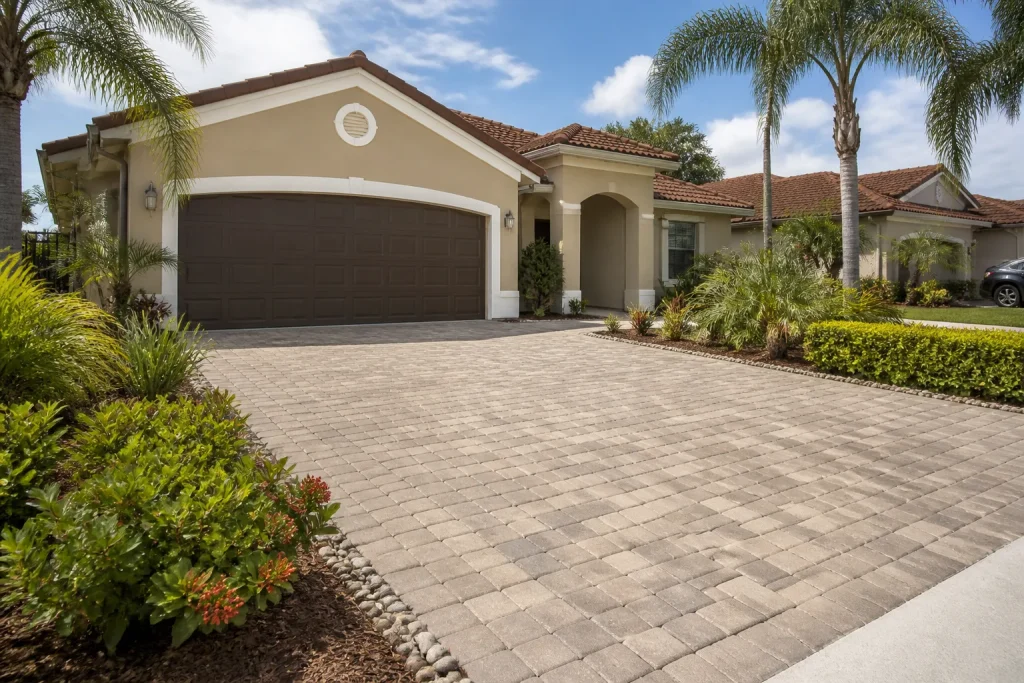
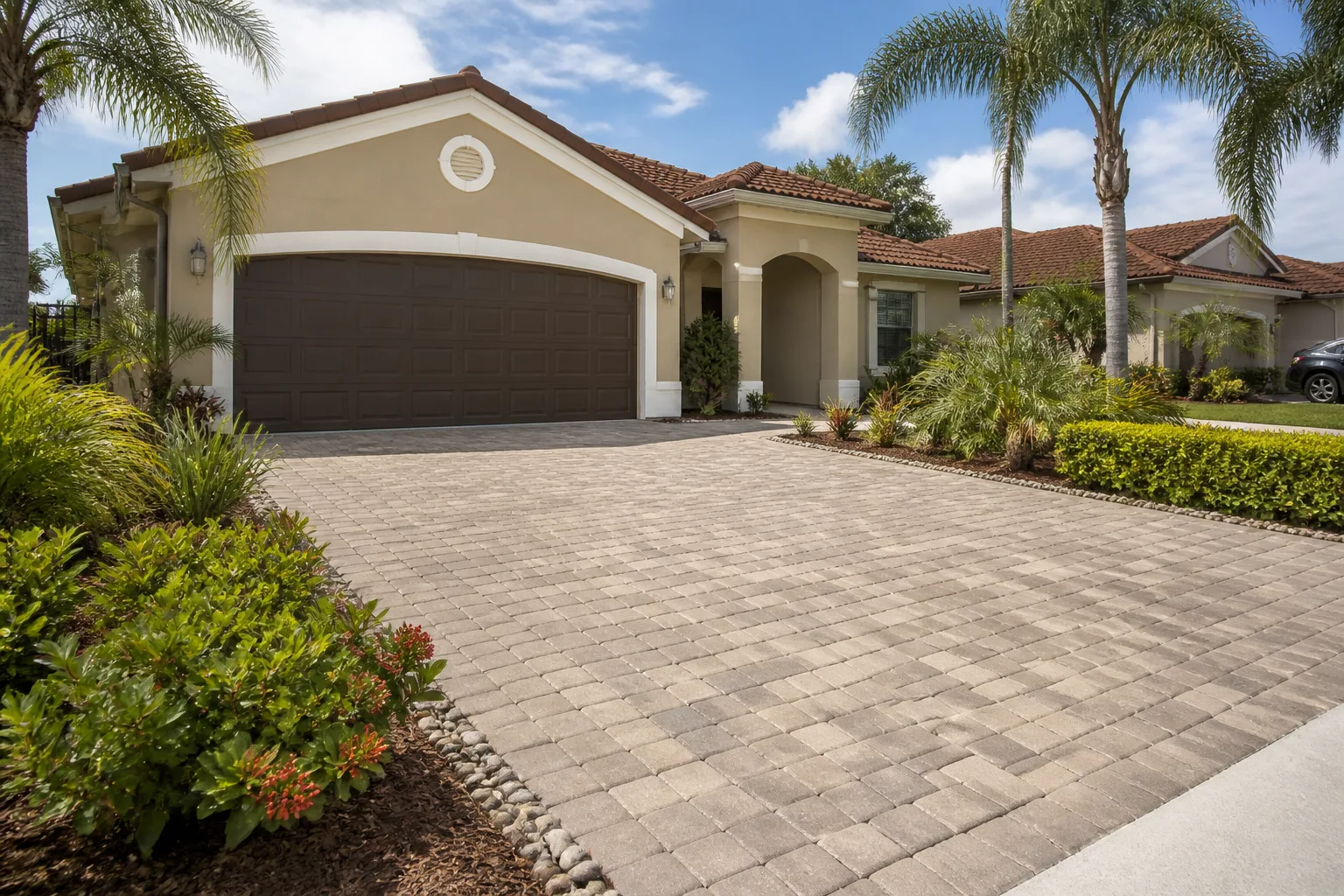
A typical job in The Hammocks involves a paver driveway meeting a concrete garage slab with a short walkway junction near the front of the house. The apron gets a RENO-T detail to bridge the slab-to-paver height difference and cover the raw edge. The walkway junction gets SCHIENE. The border against the landscaping gets JOLLY. That three-profile approach covers the full perimeter and keeps the paver field from losing its line.
We’ve also seen the difference at the transition to a fence line. If the fence posts are going in along the driveway border, coordinating the paver edge with the fence system matters. Working with suppliers like Master Halco and Ameristar for the fence gives us the right material choices alongside the paver edge. Some homeowners even ask us to line the driveway border with a decorative Jerith aluminum style; it’s a good visual finish, and the fence installation work ties in cleanly. This is the “one contractor from the driveway to the roofline” advantage in practice: the edge detail, the fence line, and the paver field all get discussed together instead of being coordinated across three separate trades. If your project grows into a home addition & ADU, the same site coordination logic applies at the walls.
When to call a pro
Cutting and setting Schluter profiles against a paver field takes a steady hand and the right blade, and getting the joint tolerance wrong just recreates the problem you were trying to fix. If your driveway is already showing a lift at the apron, a rolled border, or open joints, it’s time to have it looked at. A free estimate is the simplest way to find out whether the fix is a transition detail or a larger repair. Call (844) 797-9354 to schedule yours.
Related services in The Hammocks
Paver repairs and transition detailing sit alongside our broader driveway & pavers work, and we coordinate the same project with fence installation when the driveway border meets a fence line. To see everything we handle in The Hammocks, start with The Hammocks Construction.
The Bottom Line
Schluter isn’t just a bathroom brand. Its SCHIENE, RENO-T, and JOLLY profiles are exactly what a paver driveway in The Hammocks needs at the transitions where water, movement, and trip hazards concentrate. Choose your material, we’ll handle the rest, and we’ll specify aluminum or stainless based on where the profile sits and what crosses it.
- RENO-T at the apron: bridges the paver-to-slab height difference and covers the raw edge.
- SCHIENE at the walkway: protects paver corners and keeps the seam clean.
- JOLLY at the border: keeps landscaping and gravel off the driveway surface.
- Material choice: aluminum or stainless to handle South Florida humidity without corroding like standard edging.
- Why it matters: a restrained edge prevents lateral migration, and a flush transition removes the most common insurance claim trigger.
Our technicians have up to 13 years of experience working out transition details like these, and we install to the manufacturer’s spec rather than a shortcut. If you’re in The Hammocks and want this done right, The Hammocks Construction offers free estimates. Call (844) 797-9354. We answer 24/7. Fast dispatch from 7am to 7pm, Sunday through Friday.
Frequently Asked Questions
RENO-T is the usual choice at the garage apron because it bridges a height difference between the paver surface and the concrete slab while covering the exposed paver edge. Stainless is the stronger material pick there since vehicle weight crosses the profile. A SCHIENE profile handles the walkway junction, and JOLLY suits the landscaping border. Call (844) 797-9354 for an exact recommendation after we see the site. Estimates are free.
It’s the most effective restraint against lateral migration along the perimeter. The profile creates a continuous edge that keeps the paver field from sliding outward as the bedding sand moves, which is the root cause of widening joints, uneven surfaces, and trip hazards. No edge system repairs a compromised base, though, so the subsurface has to be sound first. Call (844) 797-9354 to have your driveway looked at, and we’ll tell you whether a transition detail is enough or more is needed.
They’re built for wet, humid conditions and hold up far better than basic untreated metal edging, which rusts and fails as the seam works. Aluminum handles walkway and border transitions well, and stainless is the right call at the apron where vehicle weight and moisture combine. Our technicians have up to 13 years of experience matching materials to exposure. Call (844) 797-9354 and we’ll walk you through the options.
Driveway slope, drainage away from the structure, and threshold heights are checked at permitting and inspection, so a repair that changes the transition may require a permit. Ask your city’s building department before work begins so nothing gets flagged after the fact. We work with you to understand what’s required for your property. Call (844) 797-9354 for a free estimate, and we’ll review the scope with you. Estimates are free.
Written by the team at The Hammocks Construction.
Need Construction Help?
Call The Hammocks Construction - licensed & insured, here with fast help in The Hammocks.
(844) 797-9354